
Immunity to change
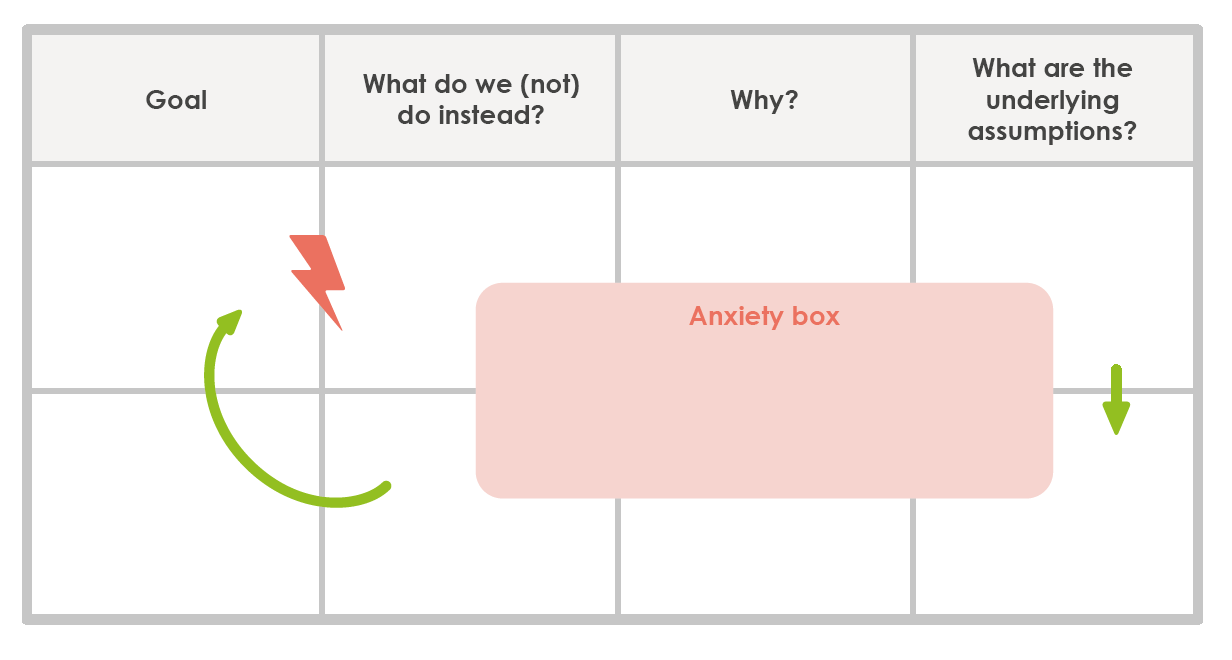
The Immunity to change shows why change is so difficult – and how it can still succeed. People and companies like to set themselves goals, only to realise that 80% of the time they are not achieved. Why is that?
Fill in the Immunity to change for yourself or with your team and you will find out what you can do to really achieve your goals.
Implementation in practice
1. Goal definition
- Start in the first field at the top left of the table.
- Agree on a single collective goal, such as “We want to reduce our administrative workload.”
- Assess its direction with the following questions:
- Do we agree that we are not doing a good enough job in this area?
- Do we agree that we can influence the achievement of the goal ourselves?
- Is it important for us to improve in this area? Are there major advantages (or disadvantages) if we do so?
It is often the case that objectives are defined as such, but are not recognised by those involved as their own. The company wants to reduce costs, while the employees would like a pay rise. No wonder employees don’t work towards a common goal!
2. What do we (not) do instead?
- Then fill in the second field at the top of the table to the right of the goal.
- List behaviours that run counter to the improvement goal. For example, if you have written down that you want to spend less time on administration, you can write “Meetings” here.
- Proceed as follows:
- Be as specific as possible.
- Don’t ask why at this point.
- Recognise the things that team members bring to the table.
3. Uncover competing, contradictory objectives
- Now go to the “Why” field on the right.
- Ask yourself why you are doing what you listed in box 2. So why are you holding so many meetings?
4. Exploring assumptions
Now you’re almost there. Each of us has assumptions that make us do things the way we do them. For example, if we believe “We need meetings so that we all have the same level of information”, then we hold a lot of meetings, which prevents us from achieving the goal in field 1.
- Now go one last time in the first row to the right into the field “What are the underlying assumptions?”. You have now reached the bottom of the table.
- Fill in all the thoughts that make you do what is written in the “Why?” field.
5. Filling in the fear box
Now you come to the heart of the matter. What would happen if you didn’t have what you listed under 4? So what would happen if you didn’t all have “the same level of information”, to use the example from above? That would probably not sit well with some people. Into the fear box come things like:
- I wouldn’t feel good.
- I would have the impression of being treated unfairly etc.
At this point, collect all the worries and fears that are offered to you by the team. Now you can see the reasons why goals are so often not achieved: People have underlying fears that prevent them from achieving goals.
6. Resolving the fears
Once you can see what stops people from achieving their goals, you can start to work on them:
- Now slide down one box in the right-hand column, again in the “What are the underlying assumptions?” box.
- Ask yourself:
- Is this an assumption or a fact?
- Is it really essential that everyone has the same level of information?
- Isn’t information more of a debt to be collected than a debt to be paid? Do we really need all these meetings or how could we organise ourselves differently?
So we could write in here: “If you want information, get it yourself.”
7. Why?
- Now go back down the line below and ask yourself: Why do you now assess 6. in this way?
- You could answer something like: “People are smart enough to know what they can find where.”
8. What do we (not) do instead?
- Now fill in the last field by sliding to the left again in the lower column into the field “What do we (not) do instead?”
- If you have travelled this far, you will find that you are now doing “Fewer meetings”. This will probably bring you much closer to your original goal.
And all because you have gone to the bottom of your assumptions! As we have already mentioned several times: change cannot be achieved at the level of behaviour. We have to go deeper. It’s worth it. Try it out!
Diese Platform ist ein Service von



