
Learning curve
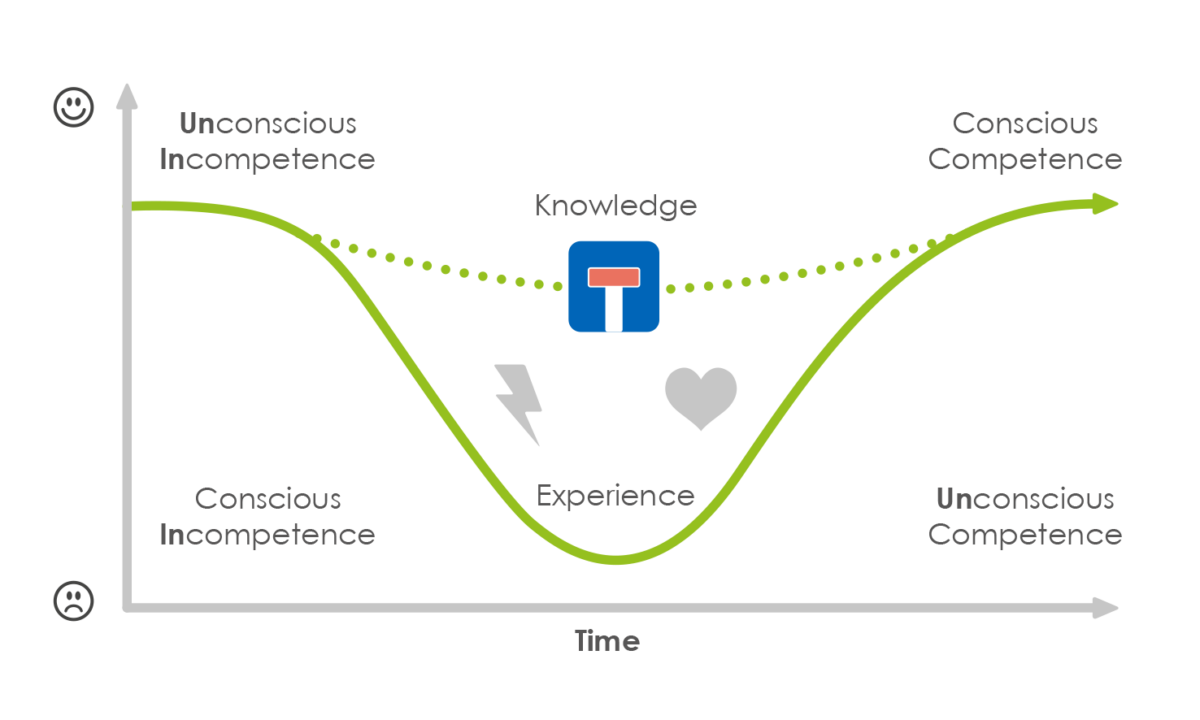
The transformation curve describes how people learn. At the beginning of a learning cycle, people do not know what they do not know. They are in the phase of unconscious incompetence. Real learning happens when people realise that they have not mastered something, i.e. when they enter a phase of conscious incompetence. This type of learning requires an active, reflective examination of concrete experiences.
his reassures us – and supposedly puts us in a state of conscious competence. However, this reflex is misleading because we are now back at the beginning of the process: we don’t know what we don’t know. Learning is not possible this way. We have to endure the fact that we are consciously incompetent. Only then do we have the space to think about why such and similar problem situations keep cropping up in everyday life.
When we move to this meta-level, we experience new solution spaces. This leads to instructive insights and to an expansion of the behavioural spectrum of a person or a team for the future. The quality of the results of a system is always based on the quality of the people who make up this system.
From the conscious confrontation with tensions and the experience that their resolution becomes an enriching experience, people enter into unconscious competence: you don’t really know what has happened, but it works! At the beginning, the new action is not yet instinctive, not yet anchored in us as a routine.
Over time, however, the new perspectives prove to be useful and we incorporate what we have learnt into our lives as a matter of course. We enter the phase of conscious competence, but in a different way than on the direct knowledge path: the new experiences expand our scope of behaviour.
This opens up new resources. Self-confidence grows, we look to the future with more confidence and positive expectations and experience ourselves as more capable of acting. And all this is only because we managers have resisted our urge to want to know.
Implementation in practice
If you want to change something, use the learning curve to prepare the team for it. After you have presented what it is about, draw the curve for your team, explain it and then ask the group:
- Where they are currently and
- How they recognise this and why.
In the next step, you then ask:
- What does it take to get one step further?
- Who could support you?
This discussion usually creates a positive team dynamic in which you can learn from mistakes and grow together.
The learning curve is generally one of the strongest images for transformation and going into depth. It can also be used in combination with immunity to change.
Diese Platform ist ein Service von



