
The paradoxical theory of change
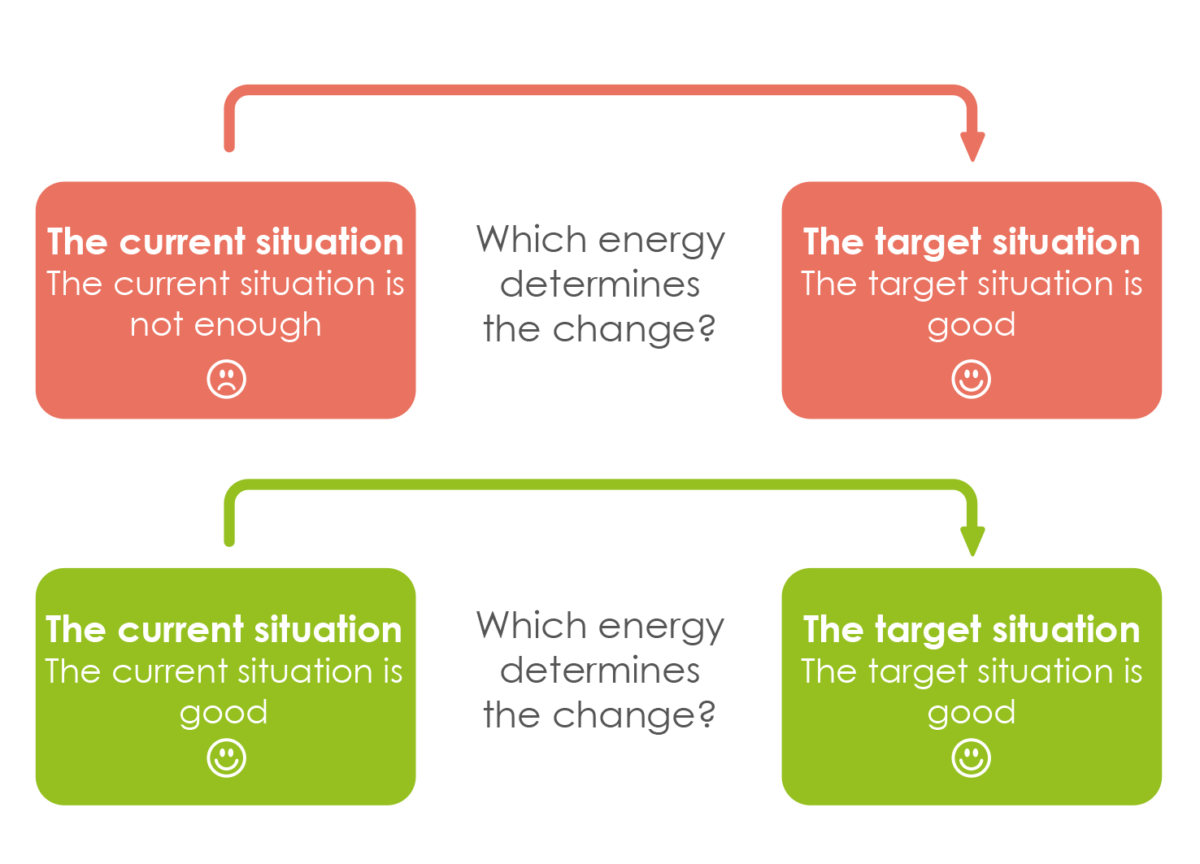
If you want to change something, you don’t have to change anything. The paradoxical theory of change in corporate transformation processes explains why so many change processes fail. When we announce to people that we want to make a change, no matter how good the arguments are, the message to the workforce is essentially this: You are not good enough. People generally react to this perception with resistance that is difficult to overcome. Those who seek to shape change in this deficit-orientated way are in the red, upper part of the diagram.
Change comes about much more easily when we build on strengths. What is currently good? What has put us in a position where we have the freedom to influence our own destiny? When we make contact with people in this way, we are much more willing to think about change. Accordingly, we apply the lower, green part of the graphic to our transformation processes.
Implementation in practice
Simple questions to bring transformations forward in this way can be:
Current situation
- What is good about the current situation? What can we be proud of?
- Where will our journey take us in the future? What opportunities will arise from this?
Transfer phase
- What does the new thing bring us together? What is the benefit for each of us individually?
- How realistic do we consider the new? How can we overcome obstacles on the way?
Target situation
- What can or do we ourselves want to contribute in order to set out on the path together?
- How can we strengthen ourselves together on this path?
Experience shows: even in this way of shaping transformation, there is room for fears and resistance. They simply do not serve as a starting point for discussion. Rather, we explore with people what they can do themselves and thus strengthen self-efficacy. As a rule, the discussion about fears thus largely fades away.
Diese Platform ist ein Service von



